At Running Niche our mission is to ensure each runner/walker leaves our store with the proper shoe which fits their unique feet, biomechanics, and mileage needs. Every runner is unique, with varying arch and foot types, weights, biomechanics, surfaces, mileage, and goals. Each running shoe fits differently. While all our products are of high quality with current technologies, the challenge is to assess your needs and appropriately recommend several options which will work. Then it all comes down to “fit and feel.” We often get asked “do you do gait analysis.” We include in our shoe fitting process, once all the above are taken into consideration, an assessment as we watch our customers run on the sidewalk so we can see how their foot interacts with the shoe and the pavement and they can feel what the shoe feels like during running or walking. Co-Owner Bob also has a MS in Exercise Physiology and a minor in biomechanics and he shares frequently with all our staff as they are fitting customers.
Foot Type Analysis
We provide a broad assessment to understand the foot type that each runner has. These generally fall into three categories:
- Low Arch/Flat Feet
- Normal/Neutral Arch
- High Arch
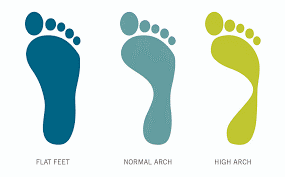
Once the foot type has been established an understanding of how it impacts gait is important. A Neutral or “Normal” arch type requires a shoe which is well cushioned, flexible and allows the foot and ankle to move through the gait cycle as it desires.
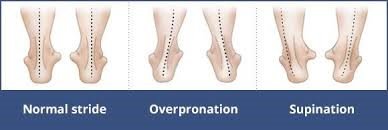
A Low Arch or “Flat Feet” may mean the runner over pronates (turns inward as shown above) and might require a shoe which provides additional support midsole medially which helps resist compression and a wider waist to the shoe. This does not hold true if the individual’s ankles and arches are strong. Support shoes generally run in a range from moderate to control. A high arched foot usually means the runner supinates and rolls outward, as shown above. This also requires specific shoe attributes which allow the foot to move naturally. Additional indicators of each of these three-foot types can be gained from viewing the outsole wear pattern of the runner, which is why it’s important you bring in your last pair of running shoes for analysis. Our assessment is also based on our experience and knowledge of working with many runners.
Foot Measuring
We take time to properly measure your feet using the industry standard Brannock device. We need to know the heel to toe length of each foot and the arch length from heel to ball. Both measurements are taken into consideration when assessing proper size. This requires experience and knowledge only gained from working one on one with many runners and assessing their size requirements. Each running shoe does fit differently so there is “art” involved as well as the literal size shown on the Brannock device.
Fit Importance
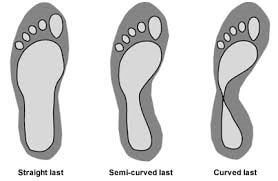
Once foot type has been established, assessing proper fit is the next critical element. Running shoes are made on a “last” which is a shape that dictates the dimensions of the heel, midfoot or “waist” of the shoe, ball girth, and toe box among other key measurements. Running shoe lasts are commonly made as straight, semi-curved and curved with variaions. Each of these last types aligns with a specific foot type: Straight/Over Pronation, Semi-Curved/Neutral and Curved/Supination. Each brand has their unique dimensions for their last’s assortment, which is why fit between brands can be quite different, even within styles within a brand. A clear understanding of the last type each shoe is made on is critical to the proper fit process. This only comes from experience working with many runners on our store floor.
Understanding certain terms is helpful for selecting the right shoe and our team is well versed in all of these by shoe as they impact the end feel and fit for the individual.
- Stack Height: The height difference between the heel and forefoot.
- Drop: The difference in height between the heel and forefoot.
- Density: The hardness of the midsole material.
- Abrasion: The outsole's ability to resist wear.
- EVA, PU, PEBAX: Different midsole cushioning materials with varying properties.
All these aspects of running shoes need to be taken into consideration when fitting runners and walkers for proper footwear. You can find Running Niche in the Botanical Heights neighborhood in St. Louis. Click here to learn more about shoe fitting: Running Niche St. Louis: Expert Shoe Fitting for Optimal Performance — Running Niche
Running Niche - Botanical Heights
1601 Tower Grove Avenue, St.Louis, MO 63110
Sponsors
-
Presenting Sponsors
-
-
Silver Sponsors
-
-
Other Sponsors
-